
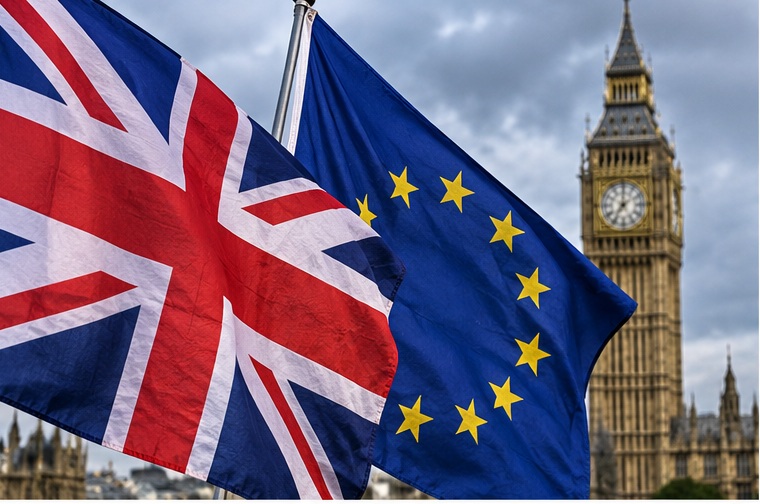
Five years after Britain completed its departure from the European Union, the political debate was shifting from whether Brexit had worked to what should come next. Full EU membership, a return to the Single Market, a customs union or simply closer cooperation with Brussels were all being discussed. But these options would lead Britain down very different paths.
On 30 September 2026, Dixi.live examined television and radio coverage across the United Kingdom, Ireland and Germany to explore how broadcasters presented the emerging debate.
The analysis highlights a central feature of the discussion: Britain's European future was no longer being framed solely as a choice between remaining outside the EU and reversing Brexit. Instead, broadcasters were examining a range of possible relationships, each carrying different political, economic and institutional consequences.
From Brexit to Britain's next European relationship
The immediate backdrop was Prime Minister Andy Burnham's speech at the Labour Party conference on 29 September, which brought Britain's long-term relationship with the European Union back into political focus.
His remarks reopened questions that had largely been settled in formal policy terms following Brexit: whether Britain should seek closer economic integration, whether another referendum might eventually be necessary, and whether full membership should remain a possibility.
Contemporary Reuters reporting also examined the range of options under discussion, from closer economic integration to the possibility of full EU membership.
By the following day, the debate had extended beyond Westminster.
European reactions, economic considerations and the practical requirements of a future agreement were becoming part of the wider discussion.
Dixi.live's monitoring captured these different dimensions across British, Irish and German broadcasts, offering a snapshot of how the issue was being presented to audiences beyond the immediate political announcement.
Rejoining the EU is not the same as moving closer to it
One of the clearest themes emerging from the monitored coverage was the distinction between different forms of European integration.
While the political debate frequently centred on the possibility of Britain rejoining the EU, broadcasters also discussed alternatives that would stop short of full membership.
German radio coverage, including Deutschlandfunk, considered possibilities ranging from a customs union and Single Market participation to a potential return to the European Union itself.
Irish coverage also addressed the relationship between future UK political commitments, economic integration and the possibility of a renewed public mandate.

These distinctions are more than technical details.
Full EU membership would restore Britain's position within the Union's political and institutional structures, subject to a new accession process and negotiated terms.
Single Market participation could provide closer economic integration through shared rules and market access, but would not automatically confer the institutional rights of EU membership.
A customs union could reduce certain barriers to goods trade while leaving other aspects of Britain's economic relationship with Europe outside its scope.
Closer cooperation could involve agreements on trade, security, regulation or specific sectors without a return to either the Single Market or full membership.
The broadcast discussions reflected an important reality: the question of Britain's European future involves several possible destinations, not a single route back.
One of the clearest illustrations came from Germany's Deutschlandfunk. In its coverage on 30 September, the broadcaster described options ranging from Britain's return to a customs union or the Single Market to full reintegration into the European Union.
The distinction is significant. These are not simply different descriptions of the same political objective. Each would involve a different level of economic integration, institutional commitment and negotiation with Brussels.
The broadcast captured a central feature of the emerging debate: Britain's European future was being discussed not as a single destination, but as a choice between several possible relationships.
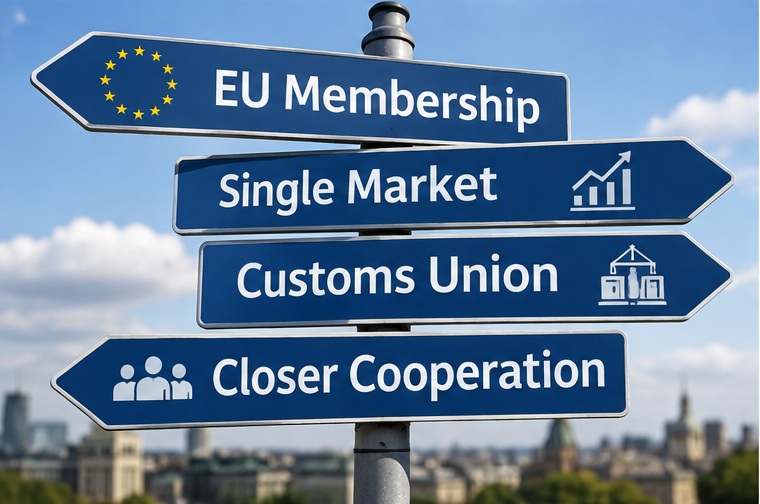
British coverage: politics, referendums and the cost of reopening Brexit
In the British broadcast material, the debate also raised questions about the political consequences of revisiting Brexit.
Could another referendum become necessary? Would a future government seek a mandate for closer integration? And what political divisions might emerge if full EU membership returned to the agenda?
BBC Radio 4 and commercial radio coverage included discussion of the referendum question and the possibility of Britain reconsidering its relationship with the EU.
Other passages explored what rejoining might involve, including the conditions Britain could face and the implications of a new agreement.
The distinction between political ambition and practical feasibility is significant.
Even if a future British government supported rejoining, the process would not be automatic. Under Article 49 of the Treaty on European Union, accession would require agreement with existing EU member states, the consent of the European Parliament and ratification in accordance with the relevant constitutional procedures.
The question, therefore, is not only whether Britain might choose to return, but whether a politically acceptable agreement could be negotiated.
In Britain, the discussion also raised the possibility of reopening the democratic question at the heart of Brexit.
A BBC Radio 4 news bulletin on 30 September reported that Labour could include a new referendum on Britain's EU membership in its next election manifesto.
That possibility would move the debate beyond economic cooperation and towards a much larger political decision. Seeking closer trade arrangements with Brussels is one proposition; asking voters to reconsider Britain's membership of the European Union is another.
The referendum question illustrates how quickly a discussion about improving UK–EU relations can become a debate about the country's long-term political direction.
The European perspective: a welcome, but not a blank cheque
The debate also attracted attention beyond Britain.
French President Emmanuel Macron welcomed the prospect of a British return to the European Union, according to contemporary reporting, while emphasising that closer integration could not simply mean selecting the benefits of membership without accepting the corresponding obligations.
His response illustrated a broader consideration that can be overshadowed in domestic British debate: Britain would not determine the terms of a future relationship alone.
Any move towards full membership would require negotiations with the EU and its existing member states, following the established EU accession process. Alternative arrangements involving the Single Market or customs union would also involve difficult choices about rules, obligations and political autonomy.
The monitored Irish and German broadcasts added perspectives on these economic and institutional questions.
Together, the available coverage shows how a debate originating in British domestic politics also raised questions about the future relationship between the UK and the wider European Union.
The prospect of Britain's return also prompted reactions from European leaders.
In a Times Radio segment on 30 September, the broadcaster reported on a press conference in Madrid where French President Emmanuel Macron welcomed the possibility of Britain returning to the EU. The report also described a positive response from Spanish Prime Minister Pedro Sánchez.
These reactions demonstrated that the debate was attracting attention beyond Westminster. But political expressions of welcome are not the same as an agreement on future membership terms.
Any application to rejoin would still require negotiations with existing EU member states and agreement through the EU's formal accession process.

Beyond the familiar Brexit argument
The significance of the discussion lies partly in how it moves beyond the political language that dominated the years surrounding the 2016 referendum.
The original referendum offered a binary choice: remain in the European Union or leave it.
The choices now being discussed are considerably more varied.
A future British government could pursue closer trade relations without applying for membership. It could seek participation in particular European arrangements. Or it could make the much larger political commitment involved in attempting to rejoin the Union.
Each option would carry different consequences for businesses, citizens, policymakers and Britain's international relationships.
The distinction matters for audiences trying to understand what politicians mean when they speak about resetting relations with Europe.
A promise of closer cooperation is not necessarily a commitment to rejoin. Equally, support for a customs union or Single Market participation does not automatically imply support for full EU membership.
The monitored coverage illustrates how these possibilities can coexist within the same political debate.
What the coverage reveals
Dixi.live's analysis of broadcasts captured on 30 September offers a snapshot of a debate that was developing along several lines at once.
British broadcasters addressed the domestic political implications of reopening Brexit, including the possibility of another referendum and the challenges surrounding a future change in policy.
Irish and German broadcast examples explored questions of economic integration, European relations and the possible forms a new UK–EU relationship might take.
These observations are not evidence of a uniform approach within any country's media. Rather, they illustrate the different dimensions of the debate visible across the monitored material.
The central finding is that the discussion of Britain's European future extended beyond the question of whether to rejoin the EU. It also concerned what kind of relationship Britain might seek, and what that choice would require.
A new debate, with old questions still unresolved
Brexit was presented to voters as a decision about whether Britain should remain in the European Union.
A future decision about Britain's relationship with Europe could be considerably more complicated.
Would the objective be to improve trade, restore economic integration, strengthen political cooperation or return to full membership? How would those choices affect sovereignty, regulation and democratic accountability? And what terms would European partners be willing to accept?
The broadcasts examined by Dixi.live show these questions entering the wider conversation.
They also reveal why the language of rejoining, resetting and rethinking Britain's relationship with Europe should not be treated as interchangeable.
Britain may once again be debating its place in Europe. But before deciding whether to return, it must confront a more fundamental question: return to what?
About this analysis
This article is based on Dixi.live television and radio monitoring data captured on 30 September 2026, covering 530 broadcast records in the United Kingdom, Ireland and Germany. The analysis draws on available broadcast transcripts and summaries, supported by editorial review and external source verification. It is a one-day snapshot of the monitored discussion, rather than a representative assessment of national broadcasting or public opinion.



Get started with Dixi Live today
Want to stay ahead of public opinion? Get real-time insights from TV, radio, and online media.
Send us a request and here's what happens next:
